
I'm 5'10 in the Morning. By 8pm I Feel 5'8.
A 24-year-old founder, a 12-hour desk, and the 3-piece posture kit I built when I realised I was leaving my chair shorter than I sat down in it.

You wake up. You measure 5'10.
You sit down at your desk by 9am. Hot desking, building, shipping, on calls. The day disappears.
It's 8pm. You shut the laptop, change your shirt, and head out to meet your friends for drinks.
Halfway through the first round you catch yourself in a mirror behind the bar. Shoulders rolled forward. Head a fraction in front of where it should be. You're laughing, you're fine — but the version of you in that mirror isn't the version that left the flat this morning.
You're 24. This is supposed to be the peak.
And it's the chair. Every time.
Morning-me and night-me felt different.
I'm 24. I run an AI SaaS startup. I stream while I build. 12-hour shifts at a desk that wasn't designed for any of it.
I started noticing it about a year in. Mornings I felt tall. Sharp. Walking around like I was 5'10. By the time I logged off, I felt compacted. Stiffer in the hips. Folded forward in the shoulders. The difference between morning-me and night-me felt like an inch and a half.
I checked the research, because that's what we do.
Turns out everyone stands up a little different after a long day than they did first thing in the morning. Studies on diurnal shrinkage put the average daily change between 0.5cm and 1.5cm. It's documented, it's universal, and it gets worse the longer your sittings are and the worse your chair is. Discs in your spine carry the load all day. Lying flat overnight resets it. Mostly.
But if you spend 12 hours a day folded into a chair that's working against your posture, the reset doesn't fully catch up. Day after day, the slouch creeps in. The presence you have at 24 isn't the presence you'll have at 34. And the compounding doesn't pause just because you're busy.
So I went hunting. For comfort. For materials research. For something that wasn't a £400 chair.
Three failure points kept showing up.

1. The lumbar curve.
Sitting flattens the natural inward curve in your lower spine. The longer the day, the more your lumbar collapses. Almost every chair under £300 leaves that gap empty.
2. The seat platform.
When the foam dies — and on a cheap chair, it dies fast — your pelvis tilts back. Your hips roll under. The slump starts at the seat and travels straight up.
3. The armrests.
Hard or low armrests drag your shoulders forward. Hours of that and your upper back rolls in. The hunch is born here.
One cushion fixes one of these.
You need to support all three at once.
This isn't just how I felt. It's documented.
I'm not a doctor. So I read the ones who study this for a living. Three findings kept showing up across the spine and ergonomics literature.
You stand a little shorter at bedtime than at breakfast. Always.
Researchers Tyrrell, Reilly and Troup measured daily height variation in healthy adults and found a mean loss of 19 mm — roughly three quarters of an inch — between morning and evening stature. More than half of that loss happened in the first hour after standing up, and around 70% was regained overnight while lying flat.
Tyrrell AR, Reilly T, Troup JDG. Circadian variation in stature and the effects of spinal loading. Spine. 1985;10(2):161-164.Your spine literally loses disc volume across the day.
An MRI study co-authored by Dr. Stephen I. Esses, an orthopaedic spine surgeon, measured a 16.2% mean volume decrease in the lower three lumbar discs after a normal day of standing and sitting. Most of the height change comes from disc volume loss — not from posture habits alone. The discs themselves shrink under load, and rehydrate overnight when the spine is unloaded.
Botsford DJ, Esses SI, Ogilvie-Harris DJ. In vivo diurnal variation in intervertebral disc volume and morphology. Spine. 1994;19(8):935-940.For desk workers, the loss compounds with back pain.
A 2019 ergonomics study tracked office workers across a single workday and measured both standing height and self-reported back pain. Both were significantly worse at end-of-day than at morning baseline. The chair didn't cause the gravity. It shaped how the body absorbed it.
Vergara M, Sancho-Bru JL et al. Spinal sagittal alignment, spinal shrinkage and back pain changes in office workers during a workday. Applied Ergonomics. 2020;82:102957.I built BackMod to take pressure off the three places the research kept pointing at — lumbar, seat, armrests — for a fraction of what an ergonomic chair costs.
So I built it.

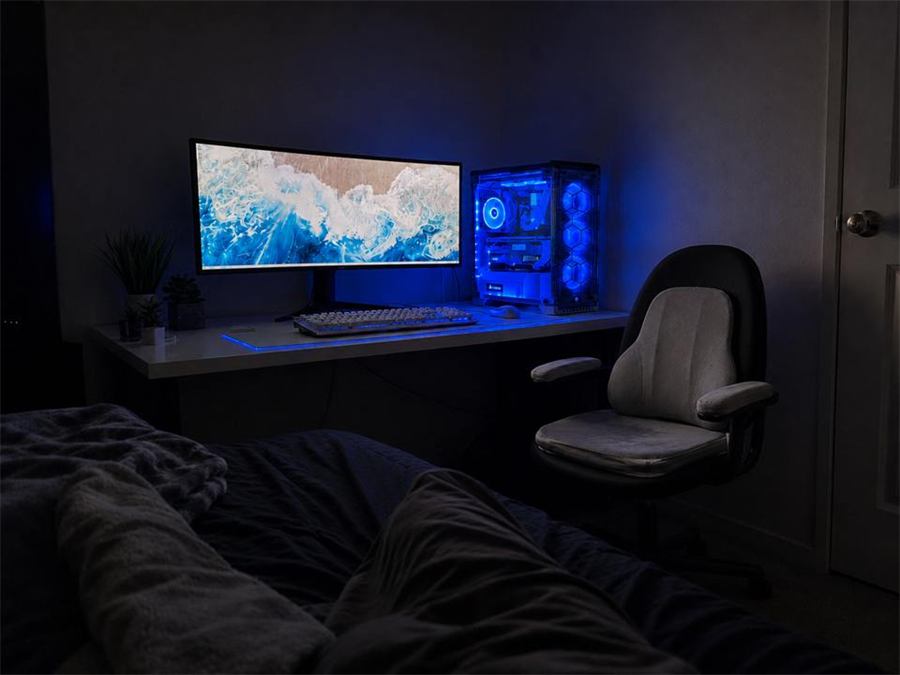
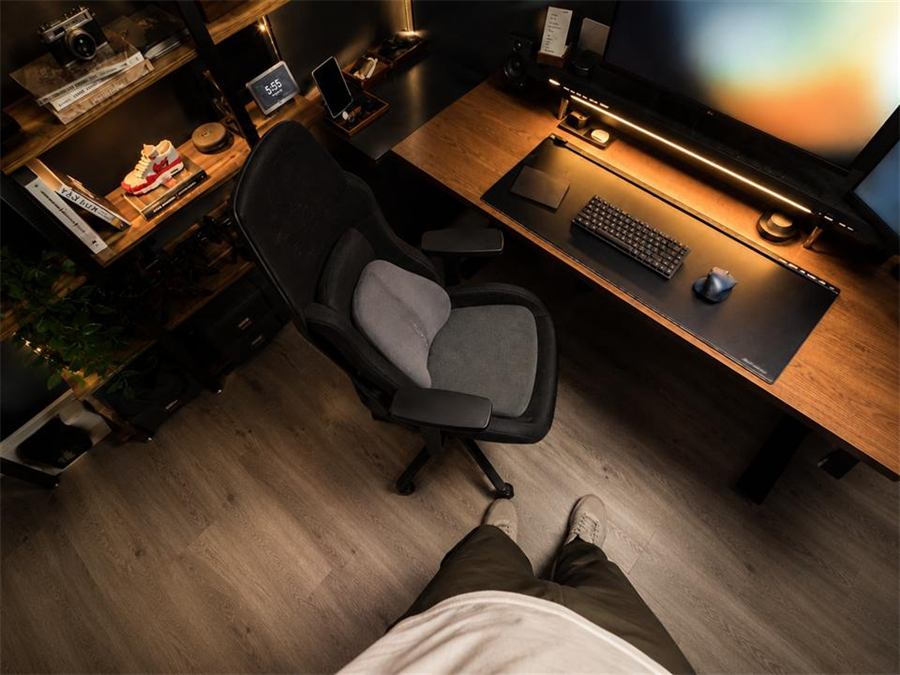
BackMod. Three pieces — lumbar, seat, armrests — high-density memory foam shaped around the exact pressure points the research kept pointing at. Designed to support an upright sitting position across a 12-hour day. Universal fit on any office chair, gaming chair, or desk chair you already own. £48.00.
It won't undo a year of slouching overnight. What it does is take pressure off the three places your current chair is letting you down — so you're not slowly folding into it across the day.
I'm 24. I'd rather take care of this now than be the guy at 40 walking into bars with rolled shoulders.
What came back.
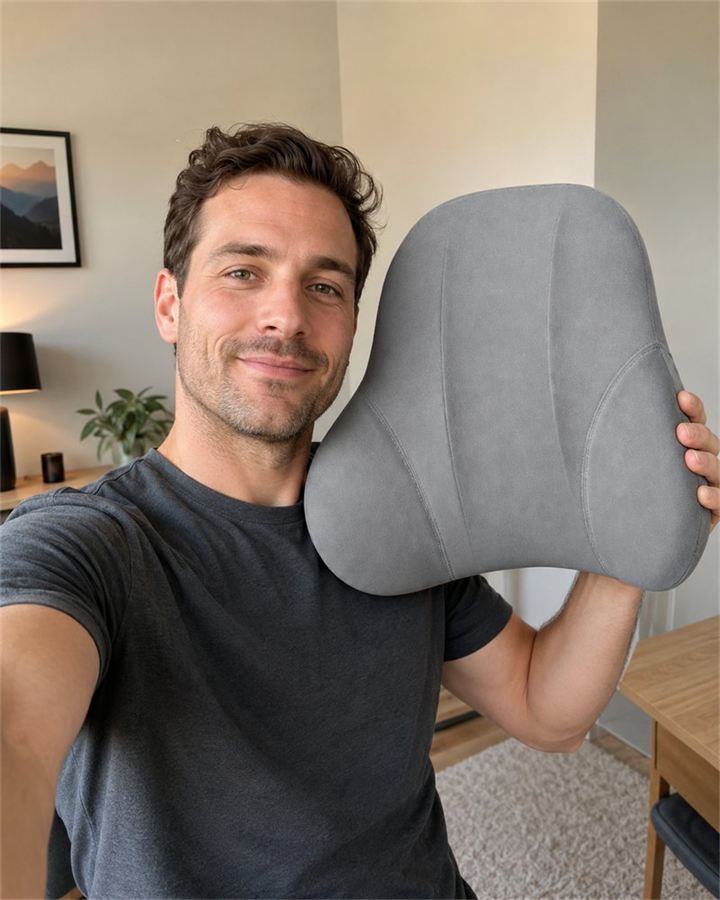
★★★★★
"I was about to drop £350 on a 'proper' ergonomic chair. Bought this instead on a whim. The lumbar piece sorted my afternoons within a week. Wish I'd known about it a year ago."
Ben T., 31 — product designer"Three weeks in, I stopped noticing my back. That's the highest compliment I can give."
Marcus T., 34 — software engineer
"I was about to spend £400 on an ergonomic chair. This was £48.00. Two months later, I haven't needed the chair."
Liam W., 29 — remote consultant
"I didn't realise how stiff I'd been ending every day until I wasn't."
Devin R., 38 — startup operator
Here's what most people do when they realise their desk is slowly hunching them.
They tough it out. Tell themselves they'll sort posture "later." Later is six months of slouching from now. The body you have at 24 is a deposit on the body you'll have at 34.
They drop £400 on an ergonomic chair. Then realise the cushioning was the problem the whole time — not the frame.
They Google "posture stretches" at 1am. Try them for three days. Stop.
They keep streaming, keep shipping, keep telling themselves it's fine. It isn't. It compounds. Quietly. While you're locked in.
I don't think you need a £400 chair.
I think you need to support the three places your current chair is failing you. That costs £48.00, ships in 48 hours, and comes with 60 days to return it if it doesn't change how you walk out of your desk at the end of the day.
The version of you that walks into the bar at 8pm should look like the version that walked out of bed at 7am.
Don't let it get too late to fix yours.
Questions before you order?
Yes. BackMod is designed to fit any office chair, desk chair, or gaming chair you already own.
Use it in your real workday, not for five minutes. If it does not change how your day ends, you have 60 days to return it.
Most people notice the pressure change during the first long session. The bigger test is how you feel when you walk away from the desk.
No. It is a three-piece pressure-point kit built around the lumbar, seat, and armrests, because one cushion only fixes one weak point.